Minimalist furniture depends on details that should disappear without compromising strength. Learning how to choose invisible hardware for minimalist furniture begins with understanding the piece’s structure, movement, and daily use. A floating cabinet may look effortless, yet its concealed brackets carry uneven loads when doors open. A flush drawer still needs accurate runners, soft closing, and enough clearance for seasonal movement.
Dieter Rams, one of the most influential industrial designers, said, “Good design is as little design as possible.” His principle applies directly here. Hardware should support the furniture quietly, not compete with its clean surfaces. Choose fittings according to load capacity, material compatibility, installation access, and future maintenance. Steel connectors may suit a heavy oak unit, while lighter panels might require different reinforcement. Moisture also matters, especially in kitchens, bathrooms, or entryways where condensation reaches hidden joints.
Do not judge hardware by appearance alone. Test a sample assembly first. Check whether screws can be tightened after the panel is installed. Listen for drawer noise. Inspect the gap under real lighting. Small mistakes become obvious on a plain surface.
There is no perfect hidden mechanism.
An experienced cabinetmaker may prefer a visible service gap because it allows safer adjustment. That choice can feel less pure, but it may improve reliability. The best solution balances concealment with access, strength, and repairability. Minimalism should remove visual clutter, not practical honesty. Reliable selection comes from specifications, prototypes, and careful observation rather than attractive product photography.
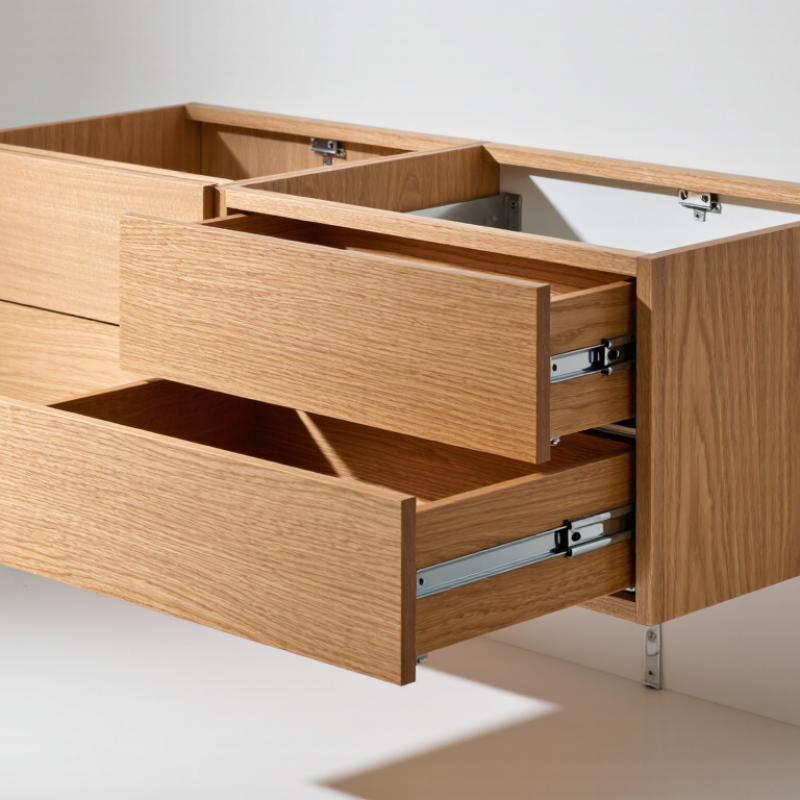
Invisible hardware refers to functional components hidden inside or behind furniture surfaces. These parts include concealed hinges, drawer runners, magnetic catches, and internal connectors. They carry loads, guide movement, and keep the design visually quiet.
In minimalist furniture, this restraint matters. A clean plane can make a room feel calmer, but only when the structure remains dependable. The hardware is unseen, not unimportant. During cabinet inspections, I check door alignment, movement, gaps, and fixing strength. A door should open smoothly without scraping the side panel. Drawers should travel evenly and close without excessive force. Soft-closing systems also need consistent adjustment. Small faults quickly become visible on simple furniture. Accurate installation matters as much as component quality. Load ratings, adjustment ranges, material compatibility, and corrosion resistance offer practical evidence when selecting fittings.
The best choice begins with the furniture’s actual use. Match the hardware to the material, door weight, and opening frequency. Solid wood may expand and contract, while engineered panels can weaken after repeated fastening. Test the fitting on a sample panel first. Do not trust appearance alone. I have sometimes chosen a smaller component because it looked neater, then found that its adjustment range was too limited. That mistake changed my process. A slightly larger concealed fitting may provide better support and easier maintenance. It may also require deeper preparation, which can affect the final design.
Invisible hardware is installed inside, beneath, or behind furniture components so that the structure remains visually clean. The chart compares typical rated load benchmarks for common concealed hardware applications. Higher capacity is useful for heavier components, but the final choice should also consider installation depth, adjustment range, material strength, and the required safety factor.
Values are representative hardware-selection benchmarks in kilograms per pair or complete set; actual ratings vary by construction, mounting method, and manufacturer specification.
Invisible hardware should be chosen after the furniture’s requirements are documented. Measure the door or drawer weight, panel thickness, opening angle, and available clearance. Note the material too. Solid wood, plywood, glass, and compact laminate behave differently under repeated movement.
Start with use conditions. A tall cabinet needs stable hinges and controlled opening. A floating shelf needs concealed supports matched to wall structure and load. A bathroom unit needs hardware resistant to moisture and corrosion. ISO 7170:2021 provides performance guidance for storage furniture, including strength and durability testing. These tests are useful references, but they do not replace checking the actual wall, fasteners, or installation method.
Safety must remain visible, even when hardware is not. The U.S. Consumer Product Safety Commission reported an estimated annual average of 15,400 emergency-department-treated injuries from furniture tip-overs among children and adults during 2018–2020. Therefore, tall or heavily loaded furniture may require anchoring, anti-tip control, or both. Hidden mechanisms should never reduce access to adjustment points.
In practice, I create a small requirement sheet before selecting components. It includes load, cycle frequency, temperature, moisture, tolerances, and service access. I also test a full-size corner sample. It reveals rubbing, weak fixing points, and awkward hand clearance quickly.
Small details matter. A two-millimeter error can expose a gap or stop a door from closing. One mistake is choosing hardware for appearance first. I have made that mistake. Minimalism is not only visual; it depends on accurate engineering beneath the surface.
How to Choose Invisible Hardware for Minimalist Furniture
Hidden hardware should be compared by strength, function, and placement, not appearance alone. Concealed hinges suit cabinet doors because they spread pressure across the mounting plate. Undermount slides support drawers while keeping the sides visually quiet. Threaded inserts and knock-down connectors work better for removable panels. Placement decides everything. A hinge near the door edge can reduce twisting. A drawer slide needs accurate, parallel installation.
The 2024 Houzz U.S. Kitchen Trends Study reports that 76% of renovating homeowners added specialty storage. This suggests stronger demand for deep drawers, pull-outs, and flexible compartments. Undermount slides are suitable for these features, but their load ratings vary widely. For heavy cookware, select a tested rating above the expected daily load. BIFMA desk and storage standards use static-load, durability, and cycle testing as useful professional benchmarks. Treat those figures as minimum evidence, not a guarantee.
I once chose a slim connector for a floating shelf because it looked perfect. It loosened after repeated loading. That mistake changed my process. I now inspect screw length, substrate density, and load direction before installation. Soft wood may need inserts or wider fasteners. Masonry requires different anchors. Hide connectors inside vertical members when possible. Use stronger hardware at stress points, and reserve lighter fittings for decorative panels. Looks clean. Strength still matters.
Minimalist furniture depends on hardware that disappears without weakening the structure. In my workshop, I compare stainless steel, coated steel, and reinforced polymer before choosing a concealed connector. Stainless steel suits humid rooms, while coated steel can work well in dry interiors. Reinforced polymer is light, but heat and repeated stress may reduce its reliability. The visible finish matters less than the load rating, corrosion resistance, and fit tolerance. Measure twice.
Installation method often decides whether a clean design stays clean. Threaded inserts provide repeatable fastening in timber, especially when panels may need future removal. Cam fittings install quickly, yet poorly aligned holes can create movement and unwanted gaps. For heavy doors, I prefer concealed hinges with adjustable mounting plates and documented load limits. A small pilot hole prevents splitting, but careless drilling still damages thin veneers. I once trusted a template without checking its offset. The door closed, though the reveal was uneven. That mistake changed my process.
Long-term durability requires testing beyond the first successful installation. Open and close moving parts repeatedly, then inspect screws, joints, and surface discoloration. In kitchens or bathrooms, choose hardware rated for moisture and clean it without abrasive chemicals. Rust starts quietly. Check whether the fastener remains tight after seasonal wood movement. A connector that looks perfect today may loosen after months of vibration. Keep installation records, including torque, material, and replacement measurements. They make repairs more predictable, although real furniture rarely behaves perfectly.
How to Choose Invisible Hardware for Minimalist Furniture
Invisible hardware should serve the furniture’s design and maintenance needs, not only its appearance. The global furniture market was valued at approximately US$516.66 billion in 2022, according to Grand View Research’s 2023 industry report. That scale reflects intense demand for durable, adaptable products. Still, a clean surface can hide difficult repairs.
For frequently used cabinets, choose concealed hinges with adjustable tension and removable doors. For drawers, specify runners rated for the expected load, not the average load. ANSI/BIFMA storage-furniture standards include repeated-cycle and load testing, so ask suppliers for tested performance data. A soft-close mechanism feels refined, but its damper may require replacement after years of use. Design access panels carefully. Tiny fasteners are easily lost.
Maintenance changes the decision. In kitchens, select corrosion-resistant components and finishes that tolerate moisture, grease, and repeated wiping. In living-room furniture, low-friction pivots may matter more than moisture resistance. The 2024 Houzz U.S. Kitchen Trends Study surveyed thousands of renovating homeowners, showing how extensively homeowners continue to update functional kitchen elements. Hidden fittings support that preference, but they are not automatically better. I have seen elegant doors sag because installers ignored panel weight and hinge adjustment. That mistake is avoidable. Leave service clearance, document compatible parts, and test the furniture under real daily use. Minimalism should conceal hardware, not maintenance problems.
It includes concealed hinges, drawer runners, magnetic catches, and internal connectors. These parts stay hidden. They still carry loads, guide movement, and support daily use.
Simple surfaces expose small faults quickly. Misaligned doors, uneven gaps, and scraping edges become obvious. Quiet design still needs dependable structure.
Match the hinge to the door weight, material, and opening frequency. Check its adjustment range and fixing strength. A hinge near the door edge can reduce twisting.
Check load rating, travel smoothness, installation accuracy, and closing force. Heavy cookware needs a tested rating above its expected daily load. Parallel installation matters greatly.
Threaded inserts and knock-down connectors are practical choices. They allow repeated assembly and removal. Choose fasteners that match the panel’s density and thickness.
Solid wood may expand and contract. Engineered panels can weaken after repeated fastening. Test fittings on a sample panel before final installation.
Not always. I once chose a smaller fitting because it looked neater, but its adjustment range was limited. A larger fitting may offer stronger support and easier maintenance.
Inspect screw length, substrate density, and load direction. Soft wood may need inserts or wider fasteners. Place stronger hardware at stress points.
Do not trust appearance alone. Check alignment, gaps, movement, and fixing strength. I once overlooked repeated loading. The connector loosened later.
Use suitable materials, accurate preparation, and corrosion-resistant components. Confirm the load rating and adjustment range. Those figures are evidence, not a guarantee.
Choosing the right concealed components is essential when learning how to choose invisible hardware for minimalist furniture. Invisible hardware includes fasteners, brackets, connectors, hinges, and supports designed to remain hidden while preserving clean lines. Begin by identifying the furniture’s purpose, weight, movement, load points, and available installation space. These factors determine whether you need strong structural connectors, discreet mounting plates, concealed hinges, or adjustable supports.
Next, compare hardware types according to strength, function, and placement. Consider materials that resist wear, moisture, and corrosion, especially for furniture used frequently or placed in demanding environments. Installation methods should suit the furniture’s construction and allow accurate alignment without weakening the surrounding material. Long-term durability also depends on secure fitting, accessible adjustment points, and simple maintenance. Finally, match the hardware with the furniture’s style, surface finish, and care requirements. The best choice offers reliable support and smooth operation while remaining visually unobtrusive throughout the product’s life.

Refa Tools